Emojis: A Digital Alphabet That We All Understand

It started out with a ‘smiley face’, how did it end up like this?

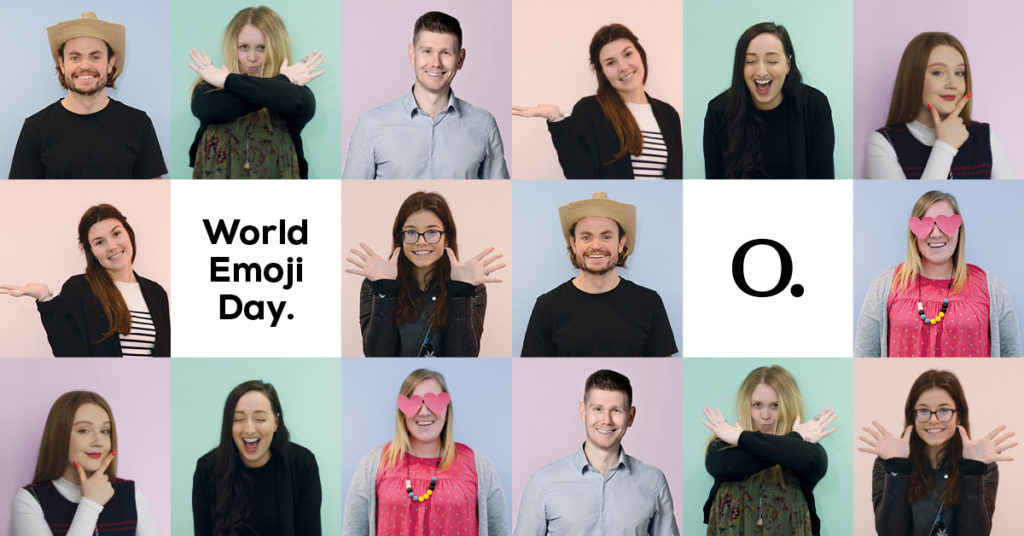
Did you know that emojis have a full day dedicated to them? It’s happening every year on the 17th of July! 🙌🏻

Whether you use them in iMessage or emails, emojis are literally everywhere. Add an emoji here and there, and your conversation is sorted without even typing a single word.

In fact, those cute little emoticons called ‘emojis’ are more than a millennial trend; they’ve changed the way we communicate! With more than 2,700 pictograms, ‘emoji’ has its own definition in the Oxford dictionary, and there’s even a movie about them.

Adorable, funny and creative, emojis are used in different ways to share your story and connect with your audience.

The story behind emojis

Remember these –  😀 and 😉 ? Well, emojis are simply an updated version of emoticons. The first emoji was designed in 1999 by Shigetaka Kurita, a Japanese artist. Kurita wanted to design a creative way to share ideas and information easily.

The first 176 emojis were more symbols than smiley faces. It was only in the mid-2000s that companies outside Japan, such as Apple, decided to incorporate and create more emojis to use on different platforms. And thus began the new era of a digital language! In 2011, Apple decided to add an emoji keyboard to iOS.

You may wonder… how are emojis created?

Have you ever thought about who actually created the avocado emoji?

Approving an emoji requires political and cultural finesse, and that’s where the Unicode Consortium intervenes.

The Unicode Consortium is not one of the villains from Star Wars. It’s a company that discusses, debates and decides which emojis can be brought into our digital world. Their purpose is to make sure that all of the text on computers is represented for every language in the world.

In 2015, the Unicode Consortium decided to upgrade the emoji game and introduced the option to change the skin tone along with adding different types of food, cultures etc.

Emojis and professional communications

Using emojis in marketing campaigns, social media, and text messages is universal. They’re fun, and they make it super easy to get to the point.

Let’s be honest – it’s better to send the pizza emoji than write “pizza”, right? Beyond this, an emoji can often encapsulate a feeling or an expression far more concisely than a sentence would.

But should you use emojis in workplace communications?

While a smiley face is one thing, sending a love heart emoji to your client is another. Adding emojis to your emails can be misunderstood by the recipient and can seriously ruin your reputation. The best thing to do is to use emojis where and when appropriate. Take time to understand your team and your clients before sending the poop emoji to anybody! 

Our favourite emojis

Love heart smiley, tacos or the rainbow, we all have our favourite emojis that we use over and over again.

Here are our staff’s most used emojis:

Pete: 🤠 “cowboy face”

Sarah: 🤗 “happy face with hugging hands”

Jessica: 🙅🏼‍ “woman gesturing no”

Becci: 😍 “smiling face with heart-shaped eyes”

Leanne: 😂 “face with tears of joy”

Kristina: 🤔 “thinking face”

Matt: 😁 “grinning face with smiling eyes”

Camille: 💁‍♀️ “information desk woman”

What are your team’s most used emojis? We’d love to hear! Send us a DM on Instagram and follow us to keep up to date with all things emojis and social media.

Ready to build, nurture or evolve your brand?

Get in touch
Contents
Posting isn’t dead. Boring content is. 👀

You can still promote your business, your services and what you do, but the way you package it matters.

Create content people actually want to stop, watch and engage with first. Sell second.

Because good marketing shouldn’t always feel like marketing.
.
.
.
.
.
.
#SocialMediaMarketing #ContentMarketing #OracoAgency
Rebranding doesn’t mean erasing everything that came before. 

If you’ve been in business for five, ten or twenty years, you’ve already built recognition, reputation, relationships and stories that have value.

The interesting part is working out what still belongs.

What should stay? What has the business outgrown? What needs to evolve? And what would you be crazy to leave behind?

A rebrand should make room for where you’re going, while still feeling unmistakably yours.

Think you might have outgrown your brand? Take another look.

Brand + rebrand projects now booking. Visit our link in bio to book a chat.
.
.
.
.
.
.
#Branding #Rebrand #BrandStrategy #BrandIdentity
I’ve always been fascinated by symbolism 🌀

By how a single mark, image, word or gesture can represent something far bigger than itself. Across cultures and civilisations, we’ve used symbols to communicate identity, beliefs, stories, belonging and ideas that sometimes go far beyond what words can explain.

And somewhere along the way, I realised that’s also how I’d started to see brands.

A logo can become a symbol of what a business stands for. A colour can carry years of recognition. A phrase can represent an entire belief. A story can become shorthand for where a business came from and why it exists. Iconography can represent services, philosophies, products or ideas.

What we see on the surface carries meaning because of everything sitting behind it.

Over nearly two decades of working in branding, I also began noticing the same themes appearing again and again in the businesses people really remembered.

Their past, beliefs, future, people, identity, expression, impact and longevity.

Eventually, I gave each of those ideas a symbolic form.

They became Oraco’s Eight Brand Marks, and today they give us a way to look at a business from eight different perspectives and uncover the stories, ideas and meaning that make it distinctly its own.

The strongest brands aren’t built by adding meaning that was never there. More often, the clues already exist.

You just need to know where to look.

Explore the Eight Brand Marks via the link in bio.
One of the hardest things about running a business is knowing what actually deserves your attention.

When you're inside it every day, everything can feel important. The website needs updating, content needs creating, marketing isn't quite working, the messaging feels off. Someone suggests a new platform, another campaign or a complete change in direction. But more activity isn't always the answer.

A big part of Jessica's work, both through Oraco and the business owners she mentors, is helping people step back far enough to see what's really going on.

– What are you actually trying to achieve?
– Who are you trying to reach?
– What's already working?
– Where is the real disconnect?
– And what can probably wait?

Sometimes the most valuable strategy isn't adding another thing to the list. It's creating enough clarity to know what matters now, what comes next and what doesn't need your attention at all.

If you're looking for strategic advice, a fresh perspective and someone to keep you accountable to actually doing the things you said you were going to do, Jessica offers one-on-one business strategy and mentoring sessions. Shoot us a DM to find out more.

ABOUT THE AUTHOR

Picture of Oraco

Oraco

We are designers, strategists, storytellers, coders, animal lovers, travellers, adventurers, yogis, gig-goers and coffee, tea & wine enthusiasts. We are for culture that fuels progressive and imaginative thoughts. We value positive change and believe in equality. We expect accountability. We aspire to create a work-life balance. We enjoy teamwork and contribution.

Leave a Reply

Your email address will not be published. Required fields are marked *

Branding Agency

Join the Oraco Passage

Build, nurture and evolve your brand with our actionable tips and insights delivered straight to your inbox.