Consider Conscious Consumption This Christmas

Before you go click crazy this Christmas, we urge you to stop and think about what you are purchasing and consider what you really need.

I know, I know… it’s weird; we are a branding agency that works with businesses to help them increase their reputation and ultimately their sales. However, this doesn’t mean we want to encourage mindless consumption. We want to promote the opposite – conscious consumption this Christmas.

Shopping is fun, we get it. There’s nothing quite like the thrill of finding a killer outfit, scoring the perfect shoes, or even spotting the ideal gift. But, in our consumerist society, we are all consuming rapidly. This is leading to a scary increase in landfill.

Globally, one in three pieces of clothing each year goes straight to landfill without being sold, while According to the Fashion Retail Council, Australians buy 14.8kg of clothing, or 56 new items, every year making Australia one of the highest consumers of textiles per capita in the world.

It also looks as though many Aussies throw out a garment after wearing it just once. What happened to giving your unused items to charity or hand me downs? Or charity shops are becoming dumping grounds for stained, torn, or broken items. Charitable Recycling Australia CEO Omer Soker advises, “the best way to identify whether an item is donatable is – if you wouldn’t give it to a friend, please don’t give it to charity.”

With Christmas just around the corner, sales will increase even further. Finder research on Australian Christmas spending habits found that the average person is tipped to splash $1,361 over the holiday season on presents, food, travel, alcohol and eating out.

A conscious consumer is merely an agent of change who considers the social, environmental, ecological, and political impact of their purchasing behaviour. It’s now more important than ever to consider conscious consumption.

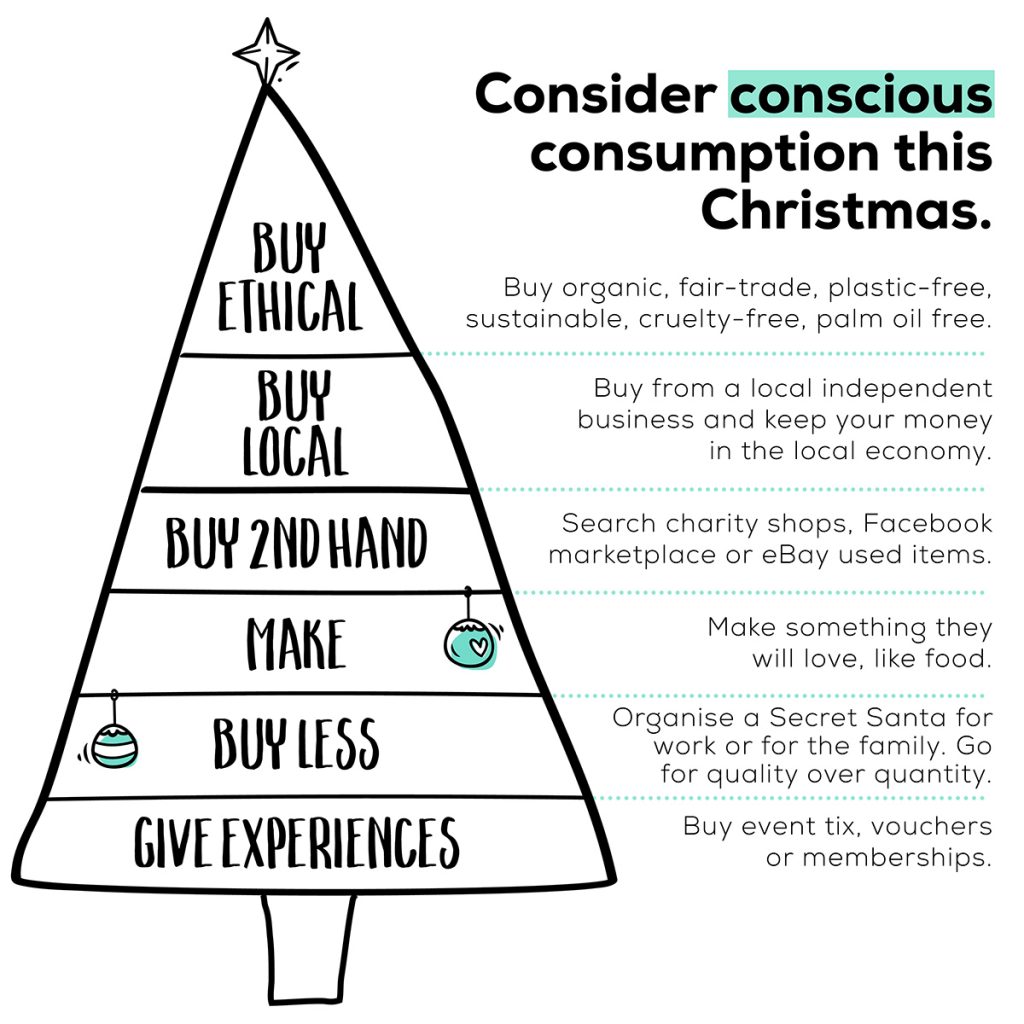
Take a stand this Christmas. Buy your loved one gifts but try to consider these principles along the way:

Be thoughtful

It’s easier said than done but think about what people actually want. Too often, we are excited by the idea or expectation that we need to give a present and as a result, gift giving may be treated as a chore. If you plan far enough in advance, you should be able to take the time to carefully consider what each of your gift recipients would like to receive this Christmas and what items would be of genuine value.

Quality over quantity

Essentially, don’t buy crap. Invest in good quality items that are more likely to stand the test of time. If you are buying clothing consider things like organic material, quality stitching, where it’s made, etc. Your friends and family will appreciate quality over quantity.

Make ethical purchases where possible

Look for ethical fashion certifications which indicate that the clothing has been made under fair and safe working conditions. When buying chocolate or coffee as a gift check to see if it’s Fair Trade. You may also like to consider organic, plastic-free, sustainable, cruelty-free and palm oil free products. These small considerations can have a significant impact on a collective scale.

We even have you covered here! We have created the first-ever inaugural Oraco Eco Holiday Gift Guide. A comprehensive collection of businesses that identify as vegan, fair trade, eco-friendly, organic, zero waste, carbon neutral, etc. This Guide has been curated for the conscious consumer who wants to spend better this Christmas. To explore the Eco Gift Guide, click here.

 

Conscious Consumption

Ready to build, nurture or evolve your brand?

Get in touch
Contents
Good work starts with good relationships.

One of our favourite parts of what we do is getting to know the people behind the businesses we work with. Understanding their stories, sharing ideas, challenging each other's thinking and seeing those ideas come to life.

Joanna Photography is a perfect example of that. We've had the pleasure of working with Jo on her brand, and more recently, the tables turned when we stepped in front of her camera for our own branding shoot.

Jo embraced our creative direction, brought her own ideas and perspective to the shoot, and captured our team in a way that felt genuinely us.

There's something pretty special about being able to support each other's businesses, collaborate creatively and share a few laughs along the way.

Thanks for being such a wonderful part of our Oraco community, Jo! 🖤
Content is easy to make, but content that actually feels like your brand is a little harder.

It's why we don't think content should begin with, “What should we post this week?”

It should begin much further back.

What do we want to be known for? What does our audience actually care about? What stories are worth telling? And how can we tell them in a way that could only really come from us?

Because when those things are clear, content stops being a constant search for something to say. You have a much stronger foundation to keep coming back to.

And that's exactly why we created the Brand Builder Map and Brand Oracle.

Built on our Eight Brand Marks™ methodolgy, the Brand Builder Map and Oracle helps you explore the foundations of your brand, uncover what makes you distinctive and develop the clarity to guide everything that comes next, including your content.

Because knowing what to say starts with understanding who you are, what you stand for and why people should care.

Here's Kannika behind the scenes capturing some of the content that brings those ideas to life.

Strategy gives you the story and content gives you somewhere to tell it.

Want to build a stronger foundation for your own brand? Explore Brand Oracle and the Brand Builder Map through the link in our bio.
Being different isn't the same as being distinctive.

A business can have a genuine point of difference and still be difficult to remember. It can also offer something remarkably similar to its competitors and become the brand people recognise first.

That's because differentiation and distinction do two different jobs.

Differentiation gives people a reason to choose you.

Brand distinction gives them something to recognise, remember and associate with you.

And while differentiation often looks sideways at competitors, distinction starts by looking inward. At the stories, beliefs, experiences, relationships and perspectives that already make a business unmistakably itself.

Because the goal isn't to be different for the sake of it but to become more confidently and recognisably yourself.

Our latest Studio Paper explores Brand Distinction vs Differentiation, why both matter and where lasting distinction actually comes from.

Link in bio to read more.

•

Studio Paper /002
Filed by: Oraco Agency
Reference: SP-002
Photo source: @joannaphotography.au
Filed under: #BrandDistinction #BrandDifferentiation #Branding #BrandIdentity
Attention and brand building aren’t always the same thing.

We believe having a perspective is one of the most important parts of building a distinctive brand. But there’s a difference between sharing an opinion because you genuinely believe it and sharing one because you know it will get a reaction.

Trends can be useful, controversial opinions can start conversations, and reach can absolutely be valuable.

But if the perspective you’re putting out there doesn’t align with what you genuinely believe, how you work or what you want your brand to be known for, what is that attention actually building?

Brand strategy is the long game.

Your perspective should have enough conviction behind it that you’re willing to stand by it long after the views, comments and algorithm have moved on.

Attention might make you visible but it’s conviction that will make you memorable.
We’ve seen some interesting conversations lately about where brand strategy ends and brand identity begins, particularly around whether things like logos, colour and typography are really that important.

Our perspective? They shouldn’t be separated in the first place.

Colour, typography, symbolism, imagery, language and tone aren’t simply aesthetic choices made once the “important” strategic work is finished.
When they’re done well, they’re strategic decisions.

They’re informed by what the brand believes, where it’s going, who it needs to connect with, what makes it distinctive and what we want people to recognise and associate with it over time.

We don’t finish the strategy and then ask, ‘Okay, what should this look like?’

The identity is already taking shape through the strategic process.

Because good brand identity is strategic thinking made visible. Not just decoration!

ABOUT THE AUTHOR

Picture of Jessica Humphreys

Jessica Humphreys

Communications Director

Leave a Reply

Your email address will not be published. Required fields are marked *

Branding Agency

Join the Oraco Passage

Build, nurture and evolve your brand with our actionable tips and insights delivered straight to your inbox.