Why Negative Comments May Not be a Bad Thing

No one likes receiving negative comments or reviews. 

Unfortunately, negative comments are often out of your control and can occur at any time. But negative comments online provide your business with an opportunity to respond and be a part of the conversation.

Not all negative comments cause harm. Sometimes, these comments can make you aware of issues that you didn’t know existed and can provide you with the opportunity to demonstrate your exceptional customer service.

However, it can be more damaging to your brand to delete these negative comments rather than deal with them.

The way your business handles negative comments is important, it demonstrates the level of customer service that you offer. One big no-no is to be defensive. Handle it like a boss, and you may turn the negativity into a positive.

We’ve put together some examples of social media fails that businesses have responded to and ultimately managed to turn the situation around.

Chevrolet

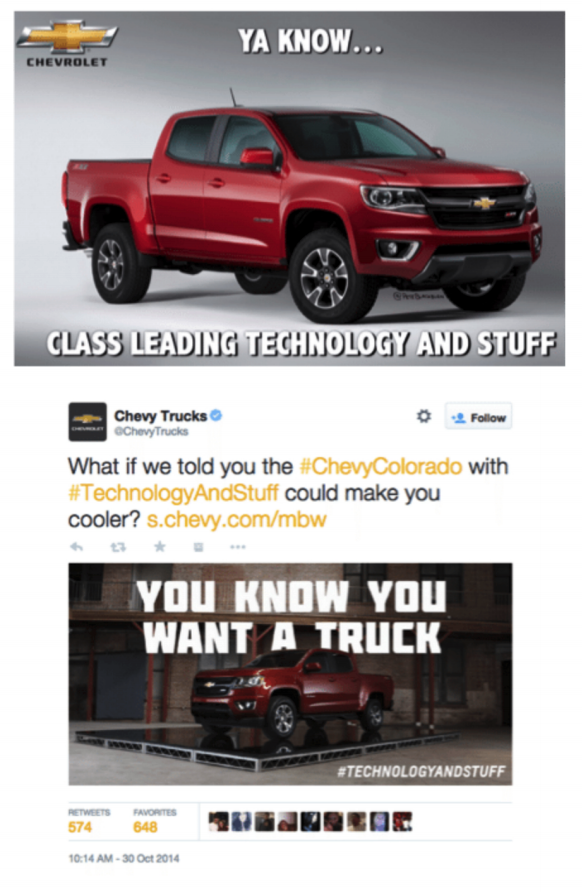
Okay, so this one is not technically a social media fail turned into a positive, but it’s a good example of a company owning a mistake and turning it into a success. Chevrolet was quick on their feet and able to avoid an epic social media meltdown.

Back in 2014, Chevrolet spokesman Rikk Wilde was presenting keys to the new Chevy Colorado Bumgarner to the MVP and the man who gave the car its name – baseball player MVP Madison Bumgarner. (Interesting fact – he is commonly known as Madbum). Rikki Wilde tried to describe the features of the truck and said, “Combines class winning and leading, um, you know, technology and stuff”.

Chevrolet was quick to own this blunder on their social media campaign by acknowledging the humour and ridiculousness through memes. It went viral on Twitter! Chevrolet turned this fumble to their advantage, and it provided them with an opportunity to add a little personality.
Woolworths

Now, poor old Woolies get their fair share (maybe even more) of negative comments on social media, especially on Facebook. Perusing their official Facebook page, there are numerous negative comments.

However, Woolworths is good at identifying a good opportunity when it presents itself.

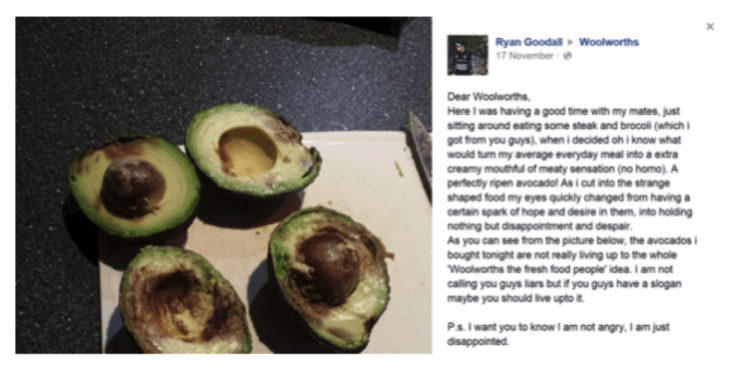
In 2014, a customer called Ryan Goodall commented on the official Woolworths Facebook page, expressing his disappointment over an overripe avocado.
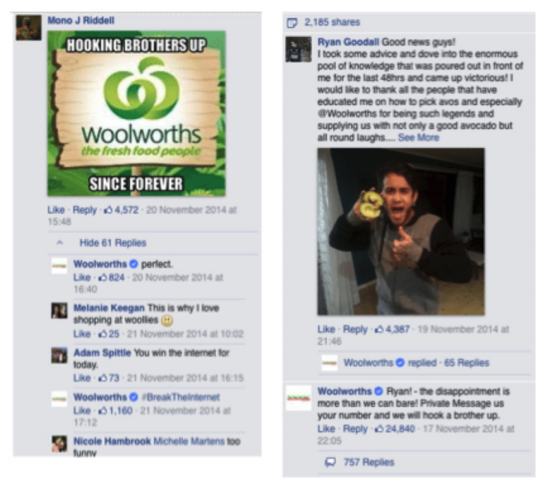
Within the hour, Woolworths addressed the issue and kept the mood light and humorous by saying, “Ryan! The disappointment is more than we can bare! Private message us your number and we will hook a brother up.” This had a positive response with other Facebook users as the post had 2185 shares, and customers creating memes.
MAC Cosmetics

MAC cosmetics shared an image on Instagram in January, from New York Fashion Week, a close up of a model’s lips wearing “Matte Royal”.
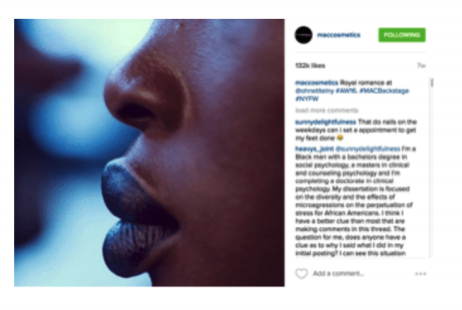

As a result, there were racist comments related to the model. There are currently over 26,279 comments on the image.
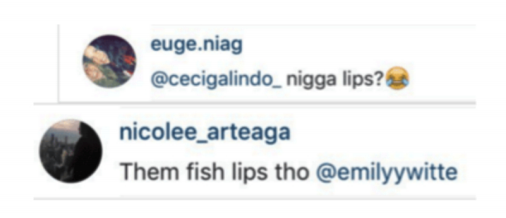
This image went viral, and Mac Cosmetics had to respond quickly. As the image was posted on Instagram, it is difficult to reply to each individual commenter so MAC addressed it in their Instagram bio, “The Official M-A-C Cosmetics Instagram. All Ages, All Races, All Sexes.”
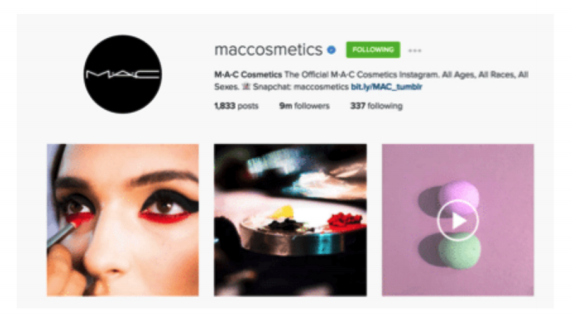
Beyoncé would be proud.

Adidas

In the spirit of Valentine’s Day and all things love and romance, Adidas posted a photo on Instagram of two ladies wearing Adidas shoes, and with the caption, “The love you take is equal to the love you make”. This image quickly gained media attention, with articles on Huffington Post to Perez Hilton and US magazine and has over 171,175 comments and 304,000 likes.

Regrettably, similar to MAC cosmetics, it was met with a number of negative comments. Adidas employed a more direct approach to handling the trolls; to show how seriously they take their zero tolerance policy with homophobia they responded to a majority of comments with a side of cheekiness by using a well-placed emoji and wishing everyone a happy Valentine’s Day. (Also Adidas has added a non-homophobic clause in their contracts with their athletes – they can’t be terminated or have a change in the contract if an athlete reveals publicly that they are lesbian, gay, bisexual or transgender – we love it!)

Bodyform

This one is an oldie, but a goodie! Back in 2012, British man Richard Neill commented on Bodyform’s Facebook Page about the misleading female product advertisements and asking why the company had “lied” about the female time of the month. The post gained popularity swiftly, gaining 104,000 likes.
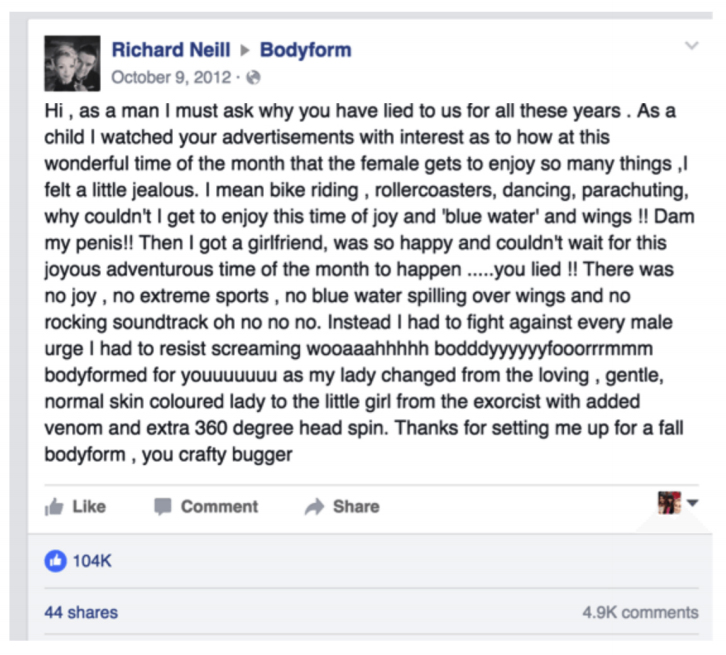
Bodyform quickly responded, and took it to the next level by creating a video to respond. The video resulting in becoming very popular with both males and females, with 5,782,937 views on Youtube alone. The tongue in cheek response was taken very well with audiences and gained a favorable outcome.

The video is hilarious and witty from the get go, the fictional CEO Caroline Williams states, “I think it’s time we came clean… We lied to you, Richard and I want to say sorry… Sorry”. She then goes on to explain why the company had to use metaphorical imagery as the men were unable to handle the truth of the “blood coursing from our uteri like a crimson landslide” and drinks a clear blue liquid.

You can watch the hilarious video here.
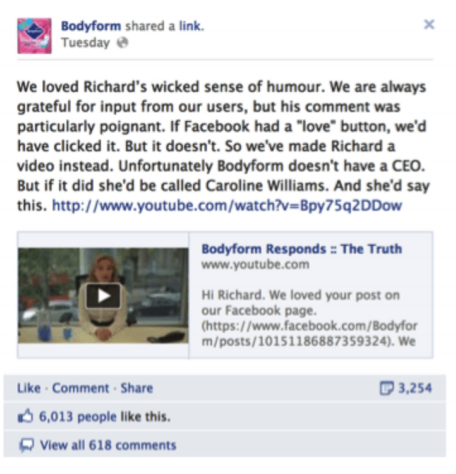
So there you have it! Negative comments don’t always result in long-term negative consequences.

These companies made the conscious decision to handle and respond to these negative situations; they have gained invaluable brand awareness, experience and a fresh perspective from consumers. They may have even gained a few followers along the way…

Get out there and respond to all of your comments – the good and the bad, like a boss, and have fun!

Still struggling? Head over to our blog on trolls and how to manage them. 

Ready to build, nurture or evolve your brand?

Get in touch
Contents
Good work starts with good relationships.

One of our favourite parts of what we do is getting to know the people behind the businesses we work with. Understanding their stories, sharing ideas, challenging each other's thinking and seeing those ideas come to life.

Joanna Photography is a perfect example of that. We've had the pleasure of working with Jo on her brand, and more recently, the tables turned when we stepped in front of her camera for our own branding shoot.

Jo embraced our creative direction, brought her own ideas and perspective to the shoot, and captured our team in a way that felt genuinely us.

There's something pretty special about being able to support each other's businesses, collaborate creatively and share a few laughs along the way.

Thanks for being such a wonderful part of our Oraco community, Jo! 🖤
Content is easy to make, but content that actually feels like your brand is a little harder.

It's why we don't think content should begin with, “What should we post this week?”

It should begin much further back.

What do we want to be known for? What does our audience actually care about? What stories are worth telling? And how can we tell them in a way that could only really come from us?

Because when those things are clear, content stops being a constant search for something to say. You have a much stronger foundation to keep coming back to.

And that's exactly why we created the Brand Builder Map and Brand Oracle.

Built on our Eight Brand Marks™ methodolgy, the Brand Builder Map and Oracle helps you explore the foundations of your brand, uncover what makes you distinctive and develop the clarity to guide everything that comes next, including your content.

Because knowing what to say starts with understanding who you are, what you stand for and why people should care.

Here's Kannika behind the scenes capturing some of the content that brings those ideas to life.

Strategy gives you the story and content gives you somewhere to tell it.

Want to build a stronger foundation for your own brand? Explore Brand Oracle and the Brand Builder Map through the link in our bio.
Being different isn't the same as being distinctive.

A business can have a genuine point of difference and still be difficult to remember. It can also offer something remarkably similar to its competitors and become the brand people recognise first.

That's because differentiation and distinction do two different jobs.

Differentiation gives people a reason to choose you.

Brand distinction gives them something to recognise, remember and associate with you.

And while differentiation often looks sideways at competitors, distinction starts by looking inward. At the stories, beliefs, experiences, relationships and perspectives that already make a business unmistakably itself.

Because the goal isn't to be different for the sake of it but to become more confidently and recognisably yourself.

Our latest Studio Paper explores Brand Distinction vs Differentiation, why both matter and where lasting distinction actually comes from.

Link in bio to read more.

•

Studio Paper /002
Filed by: Oraco Agency
Reference: SP-002
Photo source: @joannaphotography.au
Filed under: #BrandDistinction #BrandDifferentiation #Branding #BrandIdentity
Attention and brand building aren’t always the same thing.

We believe having a perspective is one of the most important parts of building a distinctive brand. But there’s a difference between sharing an opinion because you genuinely believe it and sharing one because you know it will get a reaction.

Trends can be useful, controversial opinions can start conversations, and reach can absolutely be valuable.

But if the perspective you’re putting out there doesn’t align with what you genuinely believe, how you work or what you want your brand to be known for, what is that attention actually building?

Brand strategy is the long game.

Your perspective should have enough conviction behind it that you’re willing to stand by it long after the views, comments and algorithm have moved on.

Attention might make you visible but it’s conviction that will make you memorable.
We’ve seen some interesting conversations lately about where brand strategy ends and brand identity begins, particularly around whether things like logos, colour and typography are really that important.

Our perspective? They shouldn’t be separated in the first place.

Colour, typography, symbolism, imagery, language and tone aren’t simply aesthetic choices made once the “important” strategic work is finished.
When they’re done well, they’re strategic decisions.

They’re informed by what the brand believes, where it’s going, who it needs to connect with, what makes it distinctive and what we want people to recognise and associate with it over time.

We don’t finish the strategy and then ask, ‘Okay, what should this look like?’

The identity is already taking shape through the strategic process.

Because good brand identity is strategic thinking made visible. Not just decoration!

ABOUT THE AUTHOR

Picture of Oraco

Oraco

We are designers, strategists, storytellers, coders, animal lovers, travellers, adventurers, yogis, gig-goers and coffee, tea & wine enthusiasts. We are for culture that fuels progressive and imaginative thoughts. We value positive change and believe in equality. We expect accountability. We aspire to create a work-life balance. We enjoy teamwork and contribution.

Leave a Reply

Your email address will not be published. Required fields are marked *

Branding Agency

Join the Oraco Passage

Build, nurture and evolve your brand with our actionable tips and insights delivered straight to your inbox.