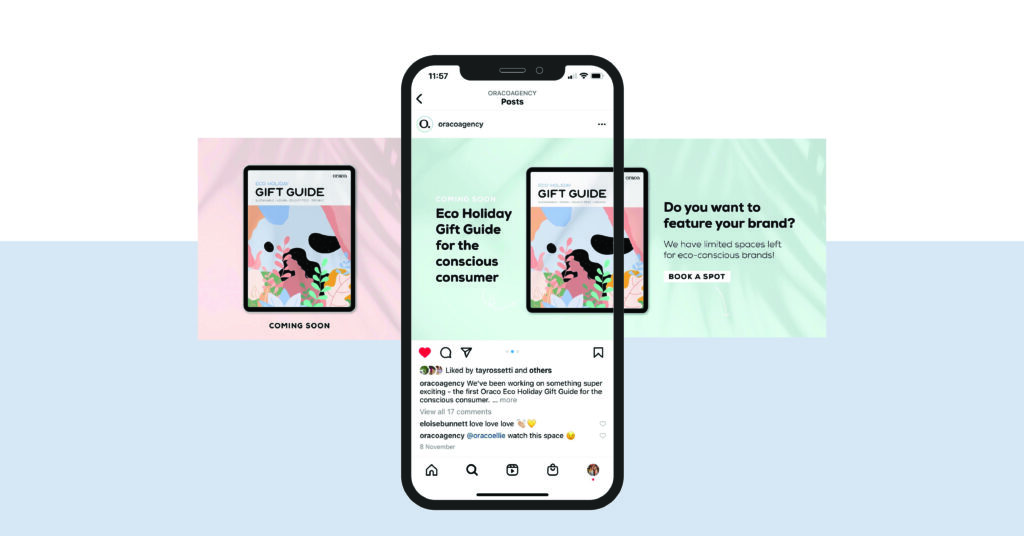
Instagram carousels aren’t just a good-looking way to fill your feed. They’re one of the most flexible content formats on Instagram, giving brands more space to educate, explain, showcase and tell a story without cramming everything into one post.
They can work particularly well when you want to slow the scroll, encourage saves and shares, or help your audience understand something in more depth.
Whether you’re a service-based business, product-led brand or content creator, the format gives you plenty of room to play.
Not sure where to start? Here are 10 Instagram carousel ideas you can adapt to your own brand, with real examples to spark some inspiration.
1. Spotlight the Features That Sell
Carousels are a great way to give your audience a closer look at a product without trying to squeeze everything into one image.
Use each slide to highlight a different feature, benefit, material, detail or use case. You might show the product from several angles, zoom in on something that’s easy to miss, or demonstrate how it works in real life.
If your product can be styled or used in different ways, even better. A fashion brand might show one piece worn across several outfits, while a skincare or haircare brand could use each slide to demonstrate different applications or results.
Why it works:
- Gives your audience more detail without leaving the post
- Helps communicate value clearly
- Can answer common questions or objections visually
- Encourages people to keep swiping
View this post on Instagram
A post shared by Aurora Spa & Bathhouse | Sorrento (@auroraspaandbathhouse)
2. Share a Transformation
Before-and-after content is almost made for the carousel format.
Instead of placing both images side by side, give each stage its own space. This helps the transformation feel more dramatic and gives your audience a clearer sense of what changed.
If the “before” image doesn’t suit your feed’s aesthetic, lead with the finished result and reveal the original image on the next slide.
This works particularly well for interiors, beauty, fitness, renovations, design, branding and service-based businesses where the value lies in the outcome.
Why it works:
- Creates an immediate visual contrast
- Demonstrates the value of your product or service
- Gives potential customers a tangible result to understand
- Adds proof without needing a lengthy caption
3. Take Us on a Journey
Carousels are ideal for storytelling because each slide can move the story forward and stories help humanise your brand and build connection.
You might share your business journey, a project from start to finish, a product launch, a milestone, a team story or a behind-the-scenes moment.
The key is to think beyond a collection of unrelated images. Give the carousel a beginning, middle and end so there’s a reason to keep swiping.
For example:
Slide 1: The hook
Slide 2: Where it started
Slides 3-5: What happened
Final slide: The outcome, lesson or next step
Why it works:
- Builds connection and personality
- Gives your brand more depth
- Keeps people engaged across multiple slides
- Makes your content feel more memorable
4. Turn a Scroll Into a Reveal
Have a wide image, campaign visual or panoramic shot that deserves more space? Split it across multiple carousel slides and reveal it one swipe at a time.
This can work particularly well for photography, interiors, architecture, packaging, campaign artwork and graphic design.
You can also use the same idea with typography or illustration, letting a message gradually unfold across each slide.
Why it works:
- Creates curiosity
- Makes a static image feel interactive
- Encourages people to swipe through the full post
- Gives visual work more impact
View this post on Instagram
A post shared by ToyMonster International | Global Toy Creators (@toymonster_international)
5. Show Off What You Do Best
A single image might show the finished result, but a carousel can show the full story behind it.
Use multiple slides to showcase the outcome, process, key details, creative thinking or different elements of a project.
For service-based businesses, this is a particularly useful way to demonstrate what working with you actually looks like.
For example, a branding agency might show:
Slide 1: The final identity
Slide 2: The original brief
Slide 3: Strategy or concept
Slide 4: Logo system
Slide 5: Packaging
Slide 6: Digital applications
Why it works:
- Builds credibility
- Demonstrates your expertise rather than simply describing it
- Helps potential customers understand your process
- Gives more context to the finished work
6. Show the Range
If your product comes in a variety of colours, sizes or styles, a carousel post is the perfect way to show off the full range, without cluttering a single image. Each slide gives your audience a clear, focused view of what’s available.
You can also group products into smaller edits such as:
- New arrivals
- Seasonal favourites
- Bestsellers
- Staff picks
- Gifts under a certain price
- A particular collection or theme
Why it works:
- Makes your range easier to browse
- Helps customers compare options
- Keeps the content visually clean
- Can increase interest across multiple products
7. Ride the Photo Dump Trend
Photo dumps are a simple way to make your brand feel more relaxed and human.
They usually combine a collection of loosely connected images around a moment, event, month or theme.
Think:
- A week in the studio
- Behind the scenes at our latest shoot
- Things we loved this month
- Highlights from launch week
They don’t need to feel perfectly polished. In fact, the appeal is often that they feel more spontaneous and less campaign-driven.
Why it works:
- Adds personality to your brand
- Gives your audience a behind-the-scenes view
- Works well for community and culture content
- Creates variety within an otherwise polished feed
8. Teach Something Worth Saving
Educational carousels are one of the easiest ways to turn your expertise into useful social content.
Break a topic into small, easy-to-understand points and use each slide to explain one idea.
Formats that work well include:
- 5 quick tips
- Common mistakes
- Myth vs fact
- Things to know before…
- A beginner’s guide to…
- What we wish more people knew about…
Keep each slide focused on one point and avoid trying to fit an entire blog post into a single carousel.
The goal is to make the information easy to absorb and useful enough that someone may want to save it for later.
Why it works:
- Gives your audience practical value
- Encourages saves and shares
- Demonstrates your expertise
- Can turn one topic into an entire series
9. Break Down a Process or Method
If something is easier to understand step by step, turn it into a carousel.
This might be:
- How to use a product
- How to book a service
- How your process works
- How to complete a task
- How you approach a particular strategy
- What happens after someone becomes a customer
You can use text, imagery, short video clips or a combination of all three.
For more complex services, this can also help reduce uncertainty by showing potential customers exactly what to expect.
Why it works:
- Makes complex information easier to understand
- Removes friction
- Helps set expectations
- Positions your process as part of your value
10. Curate a Mini Catalogue
Instagram carousels can now include up to 20 photos or videos, giving brands even more space to create mini collections, product edits or catalogues.
You might use a carousel to showcase:
- Bestsellers
- New arrivals
- Seasonal products
- Gift ideas
- A complete collection
- Staff favourites
- Products for a particular need or occasion
Keep the first slide strong and make sure each following slide adds something new.
Why it works:
- Gives your audience plenty to explore
- Makes browsing feel easy
- Lets you showcase more products in one post
- Can support product discovery without overwhelming the feed
A Few Extra Carousel Ideas
Once you start thinking in slides rather than single posts, the possibilities open up quickly.
You could also try:
- FAQs
- Testimonials
- Customer reviews
- Case studies
- Team introductions
- Predictions or trend reports
- Checklists
- Do-this-not-that comparisons
- Event recaps
- Client results
- Moodboards
- Seasonal inspiration
- Quote collections
- Product comparisons
- Common mistakes to avoid
The best carousel ideas usually start with one simple question:
What would be clearer, more useful or more interesting if I had several slides instead of one?
Our Favourite Tools and Resources for Social Content
If you create social content regularly, a few reliable tools can make the process much easier.
For filming, we use the Rode Wireless Micro for audio and the DJI OM 6 when we want smoother phone footage.
For more ideas around content planning and storytelling, The Content Fuel Framework by Melanie Deziel is a useful resource for generating content themes, while Likeable Social Media explores practical ways brands can create more engaging social content.
Whatever tools you use, strategy still comes first. A beautifully designed carousel won’t do much if the idea isn’t relevant to the person seeing it.
Keep Exploring
Instagram carousels are one of the most versatile formats available to brands.
You can use them to educate, tell stories, showcase products, demonstrate your expertise, explain a process or simply give your audience something worth swiping through.
If you’re looking for more ideas, explore our latest articles on social media and content strategy.
And if you’re an Australian business looking for support with social strategy, content creation or creative direction, the Oraco team can help. Book a content strategy session here or follow us here for more tips.