
For those of you who have been working in the business for a while, you would have heard the word strategy being used in meetings, and it’s likely you have used it yourself! The word strategy is a broad term and can be applied to almost any marketing activity. With this in mind, we thought it would be an ideal opportunity to break down what strategy means and then expose some theories and myths surrounding it.
What does strategy mean?
Let’s kick things off with the definition of strategy and how it applies to business.
According to the Dictionary, the definition of strategy can mean:
- “A careful plan or method
- The art of devising or employing plans or stratagems towards a goal
- An adaption or complex of adaptions (as of behaviour, metabolism, or structure) that serves or appears to serve an important function in achieving evolutionary success”
Unfortunately, there is not one overarching definition of strategy that is a ‘one size fits all’ approach, as it is such a broad term. Forbes Magazine has broken it down, saying, “Stripped down to its very essence, strategy is an organisation’s unique way of sustainable value creation.” This is the best example of what strategy means in business as it applies to the crux of what a strategy intends to do, allowing your business to grow and change effectively internally and externally.
Let’s bust some strategy myths!
Now we have covered what strategy means, let’s delve into some common strategy myths. We will further expand on these myths and break them down to reveal the truth!
Strategy Myth 1:
Your marketing plan and strategy are the same things
FALSE!
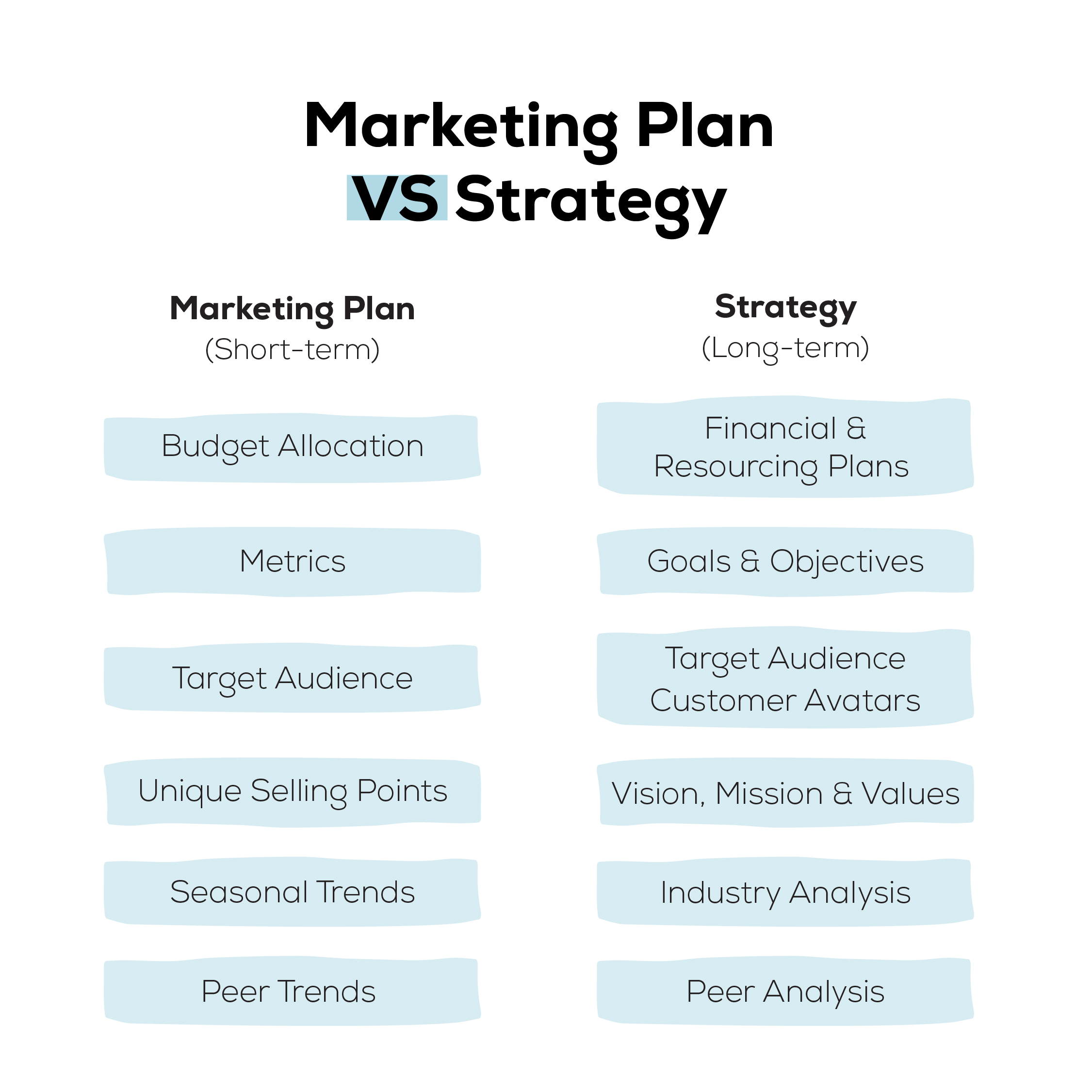
According to Indeed, “A marketing plan includes the detailed steps you’ll take to achieve the established marketing goals or overarching strategy of the business or a specific campaign.” A marketing plan allows you to plot your tactical approach to achieving your business’s goals. The business goals would have been determined in the strategy phase. A lack of strategy may mean that your marketing plan will lack direction and focus.
Without a pre-determined strategy, your marketing plan may not deliver the ideal outcome for your business because your strategy reflects on a suite of big picture plans, including a SWOT (Strengths, weaknesses, opportunities and threats), target audience and customer avatars and peer analysis. Without this overview, it can be challenging to market – especially if you don’t know whom you are marketing to! For easy reference, we have provided a breakdown below to reflect the main differences between a marketing plan and a strategy:
Strategy Myth 2:
You don’t need a defined target audience to proceed with a strategy
FALSE!
We understand that a strategy is a big undertaking. As this is primarily an in-house plan that guides your business’ growth, it can be easy to cut out some of the work and drop off topics that aren’t immediately required. This may mean that when it comes to determining your target audience, it can be easy to skim over this topic quickly. Unfortunately, if you do this, it can set your business up to fail in the future.
Well-known Marketing author Philip Kotler stated, “There is only one winning strategy. It is to carefully define the target market and direct a superior offering to that target market.”
This statement justifies your need to define your target audience within the strategy phase. Without this, you don’t have a clear individual (or group) in mind when considering your future goals and plans. If you have a strategy without a defined target audience, we recommend revisiting your strategy to expand on this ASAP!
Strategy Myth 3:
Once your strategy is done, you don’t need to update it again
FALSE!
You may have an air-tight strategy that has held your business in good stead for a few years now. That’s great – but have you read through it thoroughly lately? You may find that some areas need updating, such as your peer analysis or key messages. If this is the case, your Goals and Objectives will need to shift, likely impacting all other areas of your strategic plan.
According to Plastic Business Mag, “…the number one driver of revenue growth is the reallocation of resources throughout the year from underperforming areas to areas with greater potential. Strategy is the primary vehicle for making these vital resource reallocation decisions…If strategy in your organization is an annual event, you will not achieve sustained success.” It is pivotal that you review your strategy multiple times a year. Set up a bi-monthly reminder in your calendar, bring the team together and review collectively. There won’t always be changes required, but it helps you identify areas that need improvement, uncover potential threats, and adapt to the current climate.
Strategy Myth 4:
A strategy is only needed for bigger businesses
FALSE!
Regardless of your business’s scale, having a strategy is essential for your growth and success. According to Keap, a CRM development business, “you have to know what you want to accomplish before you can go out and do it. That means having a clear vision and the ability to articulate exactly what success looks like”. If you’re just starting out or are a globally renowned company, having a solid strategy will guide you as your business develops.
Oksana Kolesnikova, CEO/Founder of Oksana Franchising International Inc., put it perfectly when she said, “With patience, determination and strategy, you can achieve significant growth for your small business. Success doesn’t happen overnight, but staying committed to your business practices will lay the groundwork for expansion.”
Strategy Myth 5:
Having a strategy is restrictive and doesn’t allow your business to be agile
FALSE!
As previously established, having a strategy allows for clarity, guidance and prompts planning for consistent growth. This also means that your strategy will need to develop over time to adapt to external factors too. This can include changes such as internal resourcing, political shifts, and emerging trends. Considering your strategy as a fluid guide helps remove the stigma or feeling of being restricted by it.
The Harvard Business Review outlined the importance of business and strategy flexibility by stating, “Under uncertainty, traditional approaches to strategic planning can be downright dangerous.” They went on to outline that “Underestimating uncertainty can lead to strategies that neither defend against the threats nor take advantage of the opportunities that higher levels of uncertainty may provide.” It is ideal to ensure your perception of your strategy is positive. It supports you and provides a safety net to fall back on when you require focus and direction. However, if it needs to be adapted to align with current circumstances, revisit your strategy and tweak it as needed.
For those who have a strategy in place, well done! Your work isn’t done there, though. We recommend going back and reviewing it. Ensure that your strategy is aligned with your current situation. If it is a few years old, then it may be time for an update. If you haven’t got a strategy, there’s no time like the present. Ensure you do your research and take time to properly flesh out a solid strategy to hold your business in good stead. If putting a strategy together feels overwhelming, please reach out. We’re here to support you throughout your business journey, including one of the most important initial phases: creating a strategy.